
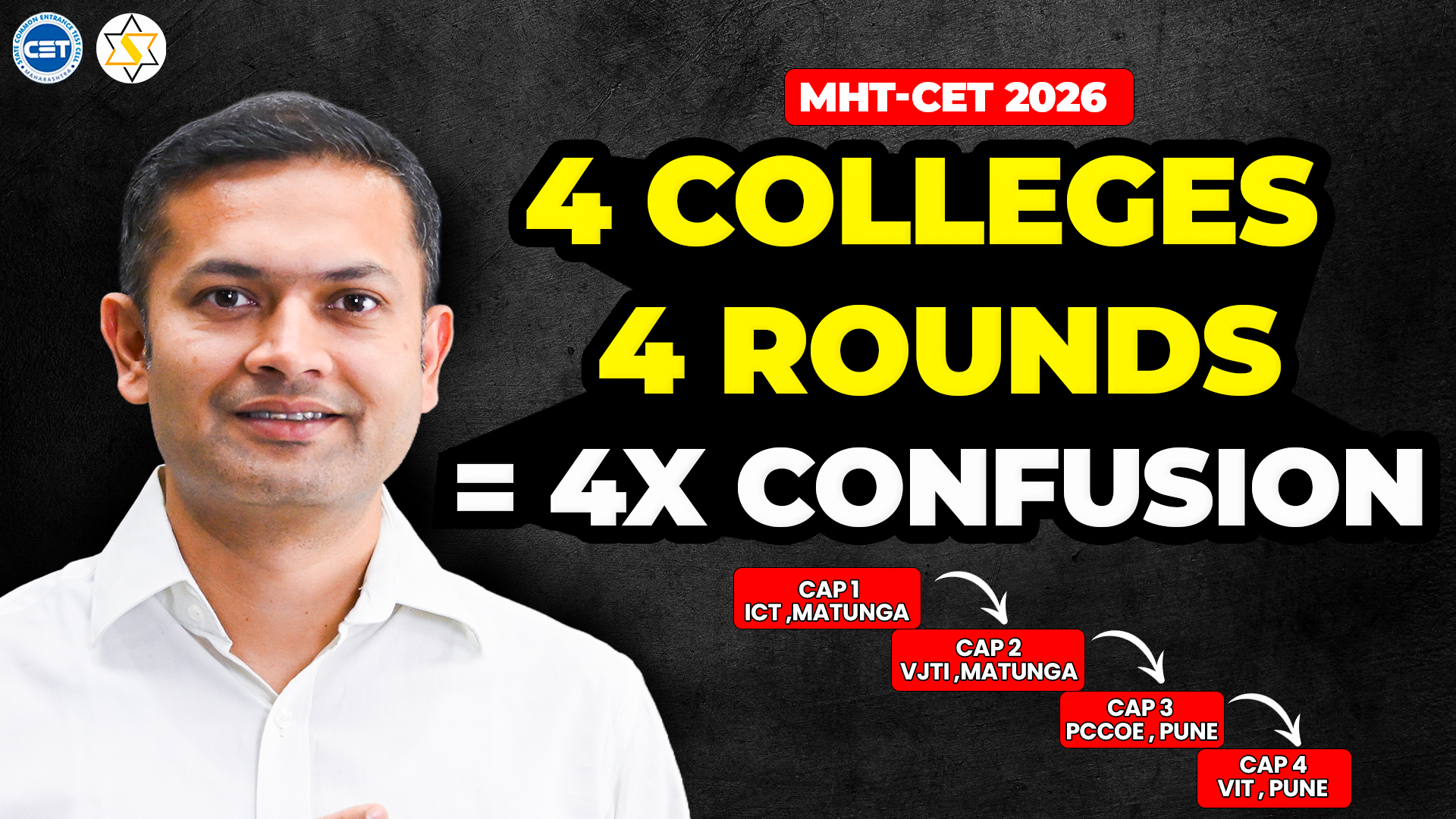
One mistake on the MHT-CET preference form cost a 98.7 percentile student their dream college. 4 colleges in 4 CAP rounds – that is exactly what happened to one MHT-CET student with 98.7 percentile in Open category. A student with a score good enough for top-tier colleges ended up bouncing between ICT Mumbai, VJIT, PCCOE, and VIT Pune across four consecutive CAP rounds. Same student, same score, four completely different colleges. This is not a system error. This is what confusion about the MHT-CET preference form looks like in real data.
Most families assume they will “figure it out as rounds progress.” They enter CAP Round 1 with a vague idea, change their mind after talking to a neighbour in Round 2, listen to a coaching teacher before Round 3, and panic-select in Round 4. The CAP allotment data proves this happens to thousands of students every single year – not just low scorers, but 98+ percentile students who had every option open.
This post breaks down exactly what happened to this student round by round, exposes 5 dangerous misconceptions that cause this chaos, and shows you how to get 100% clarity before CAP Round 1 so your MHT-CET preference form actually works in your favour.
The Numbers Behind This Case Study
What Actually Happened: The 4-College, 4-Round Journey
Let’s trace this student’s actual MHT-CET CAP allotment data round by round. Application ID: 25123410. Percentile: 98.7. Category: Open. No reservation advantage needed – pure merit was enough for almost any college in Maharashtra.
| CAP Round | College Allotted | Branch |
|---|---|---|
| Round 1 | ICT Mumbai (Institute of Chemical Technology) | Surface Coating Technology |
| Round 2 | VJIT (Veermata Jijabai Technological Institute) | Production Engineering |
| Round 3 | PCCOE Pune (Pimpri Chinchwad College of Engineering) | Information Technology |
| Round 4 | VIT Pune (Vishwakarma Institute of Technology) | Computer Engineering |
Read that table again. Round 1 gave this student ICT Mumbai – one of the most prestigious institutes in Maharashtra – but in Surface Coating, a niche branch with limited placement scope. By Round 2, they jumped to VJIT in Production Engineering. Round 3 shifted them to PCCOE Pune in IT – a completely different city. Finally, Round 4 landed them at VIT Pune with Computer Engineering.
Many people will look at this and say “this is a downgrade – ICT to VJIT to PCCOE to VIT.” Others will say “they finally got Computer Engineering, so it worked out.” Both miss the real point.
Key Insight: This student was lucky – each round was technically an upgrade in branch quality. But most students who change their preference form every round end up stuck at their Round 1 allotment with zero upgradation. Having 100% clarity BEFORE CAP Round 1 is not optional – it is the entire game.
5 Dangerous MHT-CET Preference Form Misconceptions
This 4-college chaos did not happen because the CAP system is broken. It happened because the student (like thousands of others) entered the process without clarity. Here are the 5 misconceptions that cause this every single year.
“College name matters more than branch” – This is not entirely wrong, but it is dangerously incomplete. The best outcome is a strong combination of BOTH college and branch. Picking ICT for Surface Coating just because “ICT” sounds impressive on a resume is exactly the kind of half-logic that leads to regret. A good college with an irrelevant branch is not a good admission.
“The preference form is not that important” – This is the single most dangerous misconception. The MHT-CET preference form IS the admission process. The allotment algorithm runs on your preference order. A badly ordered preference list means you get allotted to option 47 instead of option 3 – even with the same percentile as someone who got their dream college.
“I don’t need to study cutoffs beforehand” – Without cutoff data, you operate on false confidence. A student with 96 percentile genuinely believes they will get Computer Engineering at COEP – until the cutoff data shows the actual cutoff is 99.09. By then, CAP Round 1 is over and the damage is done. Know the cutoffs BEFORE you fill the form.
“Take a good college now, change branch in 2nd year” – In 10 years of counseling experience, Kalpesh has not seen a single student successfully change their branch after admission. On paper, second-year branch transfer exists. In practice, colleges have strict CGPA cutoffs for internal transfers, extremely limited seats, and almost no one qualifies. Do not gamble your career on this.
“Non-CAP rounds are only donation seats” – Completely false. Non-CAP rounds include ILS (Institute Level Seats – 20% quota) and ACAP (leftover CAP vacancy) rounds where legitimate seats at good colleges go unfilled. Many families skip Non-CAP entirely because they believe it is all “management quota” – and miss genuine opportunities at colleges that had vacant seats in CAP rounds.
Why Families Keep Changing Their Mind Every Round
The root cause is simple: different people influence the decision at different stages. Before Round 1, an uncle says “college name is everything.” Before Round 2, a coaching teacher says “take CS at any cost.” Before Round 3, a neighbour’s kid just got into COEP and now the parent wants to aim higher. Before Round 4, panic sets in and the family picks whatever is available.
Every round, the student hears something new, the preference list changes, and the allotment algorithm gives a completely different result. The student in our case study was not indecisive by nature – they were being pulled in four different directions by four different advisors across four rounds.
The solution is not “ignore everyone’s advice.” The solution is to make your final decision BEFORE Round 1 using actual data – cutoff trends, placement records, fee structures, college-branch combinations – instead of opinions. Once your preference list is data-backed, no amount of well-meaning advice should change it mid-process.
Do Not Pay Agents to Fix Your Preference List
Warning: Agents charge Rs 1-3 lakhs claiming they have “inside knowledge” about which colleges to pick or that they can “manage” a seat through connections. The MHT-CET CAP allotment is a fully transparent, algorithm-driven, merit-based process. No agent can change your rank, alter the cutoff, or influence the allotment system. Every rupee paid to an agent for CAP round guidance is wasted.
What you actually need is not an agent – it is cutoff data from previous years, a clear understanding of which college-branch combinations match your score, and a well-ordered preference list. All of this information is either publicly available through DTE Maharashtra’s official website or through tools specifically built for MHT-CET students. The admission process is designed to be self-service – agents profit only because families don’t know the rules.
How to Get 100% Clarity Before CAP Round 1
The Shooin Stars app was built specifically to solve the confusion that caused this student’s 4-college journey. The Preference List Builder lets you create a customized, data-backed preference form tailored to your exact percentile, category, and college-branch priorities – so you walk into CAP Round 1 knowing exactly what you want.
The College Predictor shows you which colleges you can realistically get at your score. The College Explorer gives you detailed information on every college – fees, placements, cutoff history. And for families who want to explore beyond CAP rounds, the Non-CAP Admissions section tracks ILS and ACAP seats at every college so you never miss a legitimate opportunity.
The app also includes a Learning Hub with live seminars, foundation courses, and the MHT-CET 2026 admission timeline – everything a parent needs in one place. The web version is also available at the Shooin Stars website for those who prefer a desktop experience.
Frequently Asked Questions
Build Your Perfect MHT-CET Preference List Before CAP Round 1
Preference List Builder, College Predictor, Cutoff Data, Non-CAP Tracking – everything you need to avoid the 4-college chaos. Free download.
Download Shooin Stars App – Free